Your website is often the first place potential customers interact with your business. Before they call, request a quote, book an appointment, or visit your location, they usually visit your site to decide whether your company feels credible and professional.
That is why an outdated business website can quietly hold a business back. Even if your services are excellent, an old, slow, confusing, or difficult-to-use website can create doubt and reduce conversions. In many cases, business owners do not realize the problem until leads decline, competitors look stronger online, or customers mention issues directly.
A small business website redesign is not only about making a site look newer. Done correctly, it improves user experience, performance, mobile usability, search visibility, trust, and lead generation. The challenge is knowing when a redesign is truly necessary and when smaller updates are enough.
This guide explains the most common signs your website needs a redesign, what to review before making a decision, and how to approach the process strategically.
Why website redesign decisions matter
Many small businesses keep the same website far longer than they should. That is understandable. A website may still be live, the phone may still ring, and updating it can feel like something to deal with later.
But websites age in ways that are not always obvious from the business owner’s perspective. Design trends shift, technical standards change, mobile expectations rise, and search engines place more importance on speed, usability, structure, and trust signals. A site that felt modern five years ago may now create friction at every step of the customer journey.
A thoughtful redesign can help a business:
- Build stronger first impressions
- Improve mobile usability
- Increase inquiries and conversions
- Make content easier to manage
- Support SEO and digital marketing campaigns
- Improve website speed and security
- Better reflect current branding, services, and goals
The key is identifying whether your current website is still helping your business or quietly slowing it down.
Signs your website needs a redesign
Your website looks outdated compared to competitors
One of the clearest warning signs is simple: your website feels old. Visitors may not say it directly, but they notice when a site looks behind the times. Common visual signs include dated layouts, inconsistent fonts, heavy use of old design elements, crowded pages, poor image quality, and a lack of visual hierarchy.
For many small businesses, trust is influenced by appearance. If a competitor’s website looks cleaner, faster, and easier to use, customers may assume their business is more established or more professional, even if your real-world service is excellent.
An outdated business website can make people question whether the company is active, responsive, or current.
Your site is not mobile-friendly
Mobile usability is no longer optional. A large portion of website traffic now comes from smartphones and tablets, and users expect a smooth experience on smaller screens.
If your website requires pinching and zooming, has buttons that are hard to tap, text that is too small, layouts that break on phones, or forms that are frustrating to complete on mobile, it may be time for a redesign.
A poor mobile experience can lead to lost leads quickly. Someone searching for a service provider on their phone may leave within seconds if the site feels difficult to use.
Mobile issues also affect search visibility, user engagement, and paid advertising performance.
Your website loads slowly
Speed affects both user behavior and business results. When a website takes too long to load, visitors often leave before seeing your content. Slow pages can reduce conversions, increase bounce rates, and weaken trust.
Common causes include oversized images, excessive plugins, outdated themes, poor hosting, bloated code, and years of layered fixes that were never cleaned up properly.
If your website feels sluggish, especially on mobile devices, a redesign may be more effective than continuing to patch isolated issues. In many cases, a rebuild with performance in mind creates a cleaner and more scalable foundation.
Your navigation is confusing
Visitors should be able to understand your website quickly. If they struggle to find services, pricing information, contact details, location information, or next steps, the site is creating friction.
Confusing navigation often shows up as:
- Too many menu items
- Unclear page labels
- Important pages buried deep in the site
- Inconsistent structure between sections
- No clear path to contact or conversion pages
A redesign can improve site architecture so users move through the website more naturally. That usually leads to better engagement and more conversions.
Your branding no longer matches your business
Businesses evolve. Services expand, target markets shift, messaging becomes more refined, and visual branding gets updated. If your website still reflects an earlier version of your business, it may no longer support your current goals.
This happens often with growing companies. The website may mention services you no longer prioritize, omit newer offerings, use outdated logos or colors, or speak to the wrong audience.
A small business website redesign can realign the website with where the business is now, not where it was years ago.
Your website is difficult to update
Many business owners delay improvements because their current website is hard to manage. Maybe editing content requires a developer for every small change. Maybe the backend is outdated, cluttered, or unstable. Maybe old tools no longer work properly after updates.
If simple tasks such as updating staff profiles, publishing content, changing images, or adding service pages are unnecessarily difficult, the site may need a stronger foundation.
A redesign should not only help visitors. It should also make the website easier to maintain, expand, and support over time.
Your conversion rate is low
Sometimes the website gets traffic, but the results are disappointing. People visit, but they do not call, submit forms, request quotes, or book appointments. This can point to conversion problems rather than traffic problems.
Possible causes include weak calls to action, cluttered layouts, lack of trust signals, poor page structure, confusing messaging, slow load times, or forms that ask for too much information.
If your website is not helping turn visitors into leads, a redesign focused on conversion optimization may be justified.
Your SEO performance has stalled
Search visibility depends on more than keywords. Website structure, page speed, mobile experience, technical health, internal linking, content organization, and user experience all contribute to organic performance.
If your rankings have stalled or declined, and the website has old architecture or technical limitations, redesigning may be part of the solution. A newer website structure can make it easier to improve crawlability, page targeting, metadata, heading hierarchy, user engagement, and content quality.
A redesign alone does not guarantee better rankings, but an outdated site can absolutely limit SEO growth.
Your website has security or technical issues
Frequent plugin conflicts, broken forms, outdated software, display issues, error messages, or recurring downtime are all warning signs. If the website is becoming fragile, continuing to patch it may become more expensive and risky than rebuilding it correctly.
Security matters especially for WordPress sites that have not been maintained consistently. An older website with outdated components may be more vulnerable to problems that damage trust and disrupt operations.
When technical debt builds up over time, a redesign can be the most practical long-term decision.
Your site was built around old business goals
Many older websites were created mainly to act as online brochures. Today, a business website often needs to do much more. It may need to support lead generation, local or national SEO, Google Ads landing pages, online scheduling, e-commerce, content marketing, trust building, and ongoing updates.
If your website was not designed to support how you currently market and sell, redesigning it can make it far more useful as a business tool.
When updates may be enough instead of a full redesign
Not every problem requires starting over. In some cases, strategic improvements can solve the issue without a full rebuild.
You may not need a full redesign if:
- The overall site structure is strong
- Your website is already mobile-friendly
- Performance issues are limited and fixable
- The branding still fits your business
- The content only needs updating or expanding
- The design feels slightly dated but not broken
Examples of smaller improvements include refreshing visuals, updating messaging, improving page speed, reorganizing navigation, replacing weak calls to action, or optimizing landing pages. The right decision depends on how many issues exist at once and how much the current platform limits progress.
Website redesign checklist for small businesses
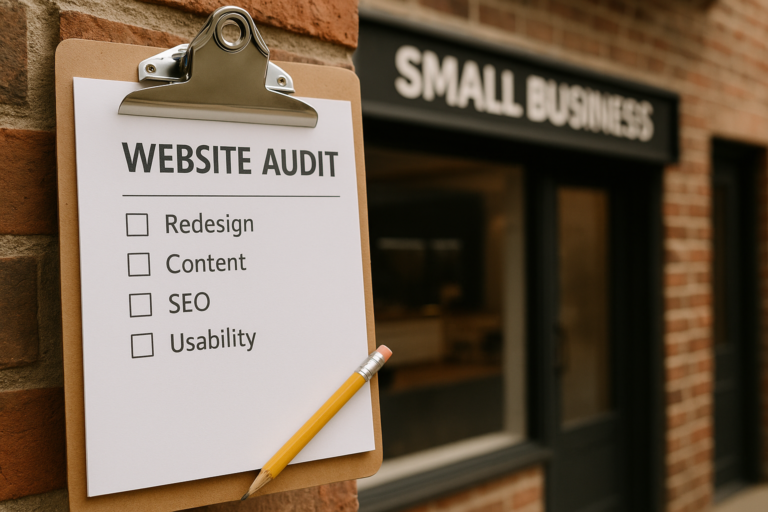
If you are unsure whether a redesign is necessary, this website redesign checklist can help you assess your current site more objectively.
1. Review first impressions
- Does the site look current and professional?
- Would a new visitor trust the business within a few seconds?
- Does the visual design reflect your brand accurately?
2. Test on mobile devices
- Does the website work well on phones and tablets?
- Are buttons easy to tap?
- Is text readable without zooming?
- Are forms easy to complete on mobile?
3. Measure loading speed
- Do pages load quickly?
- Are large images, scripts, or plugins slowing things down?
- Does the mobile version feel responsive?
4. Evaluate navigation and structure
- Can users find key information quickly?
- Are service pages organized logically?
- Is there a clear path toward contacting you or requesting a quote?
5. Check content accuracy
- Are services, staff, pricing approach, and business details current?
- Does the messaging reflect your present audience and goals?
- Are old pages or outdated offers still live?
6. Assess conversion elements
- Are calls to action clear and visible?
- Do forms work properly?
- Does the website make it easy for visitors to take the next step?
7. Review SEO foundations
- Are pages targeting the right search topics?
- Is the site structure clean and indexable?
- Are title tags, headings, internal links, and page content organized well?
8. Look for technical risk
- Is the CMS, theme, and plugin stack current?
- Are updates creating problems?
- Have there been security, downtime, or compatibility issues?
9. Consider future growth
- Can the website scale as your business grows?
- Can you add new services, locations, content, or features easily?
- Does the current setup support your long-term marketing strategy?
If several of these areas reveal weaknesses, a redesign is usually worth serious consideration.
What a successful redesign should accomplish
A redesign should do more than modernize colors and layouts. It should solve business problems. Before redesigning, define what success should look like.
Strong redesign goals often include:
- Improving trust and visual professionalism
- Making the site easier to use
- Increasing leads or inquiries
- Supporting SEO and paid traffic better
- Improving speed and technical performance
- Making content management easier
- Creating a secure and maintainable platform
For example, a contractor may need clearer service pages and quote request flows. A medical or legal practice may need stronger trust signals and a better mobile experience. A retailer may need faster product pages and simplified navigation. A consultant may need better messaging and more persuasive landing pages.
The redesign should be shaped around business goals, not just design preferences.
Important considerations before redesigning
Do not ignore existing SEO value
One of the most common mistakes in redesign projects is losing existing rankings because page URLs, content structure, metadata, or internal links are changed carelessly. If your current website has valuable search visibility, that equity should be protected through careful planning, redirects, and content mapping.
Audit what is working before replacing it
Even older websites often have pages that perform well. Before redesigning, identify which content attracts traffic, which pages generate leads, and which user paths are effective. A redesign should preserve strengths while fixing weaknesses.
Think beyond launch day
A redesigned website still needs updates, maintenance, performance monitoring, security attention, and occasional improvements. Businesses should plan for long-term support, not just the initial project.
Prioritize clarity over trendiness
Design trends come and go, but clarity, trust, usability, and performance remain essential. The best small business websites are not necessarily the flashiest. They are the ones that make information easy to understand and action easy to take.
Conclusion
If your website no longer reflects your business, performs poorly on mobile, loads slowly, feels difficult to navigate, or fails to convert visitors into leads, those are strong signs your website needs a redesign. In many cases, an outdated business website does more than look old. It weakens trust, reduces visibility, and creates friction that quietly costs opportunities.
At the same time, not every issue requires a complete rebuild. Sometimes targeted improvements are enough. The smartest approach is to evaluate the website honestly, using both business goals and user experience as the standard.
A well-planned small business website redesign should create a stronger digital foundation for the years ahead. It should help your business present itself more professionally, perform better across devices, support marketing efforts more effectively, and make it easier for customers to choose you.
If your current site is no longer doing that, it may be time to stop patching the old version and start building a better one.