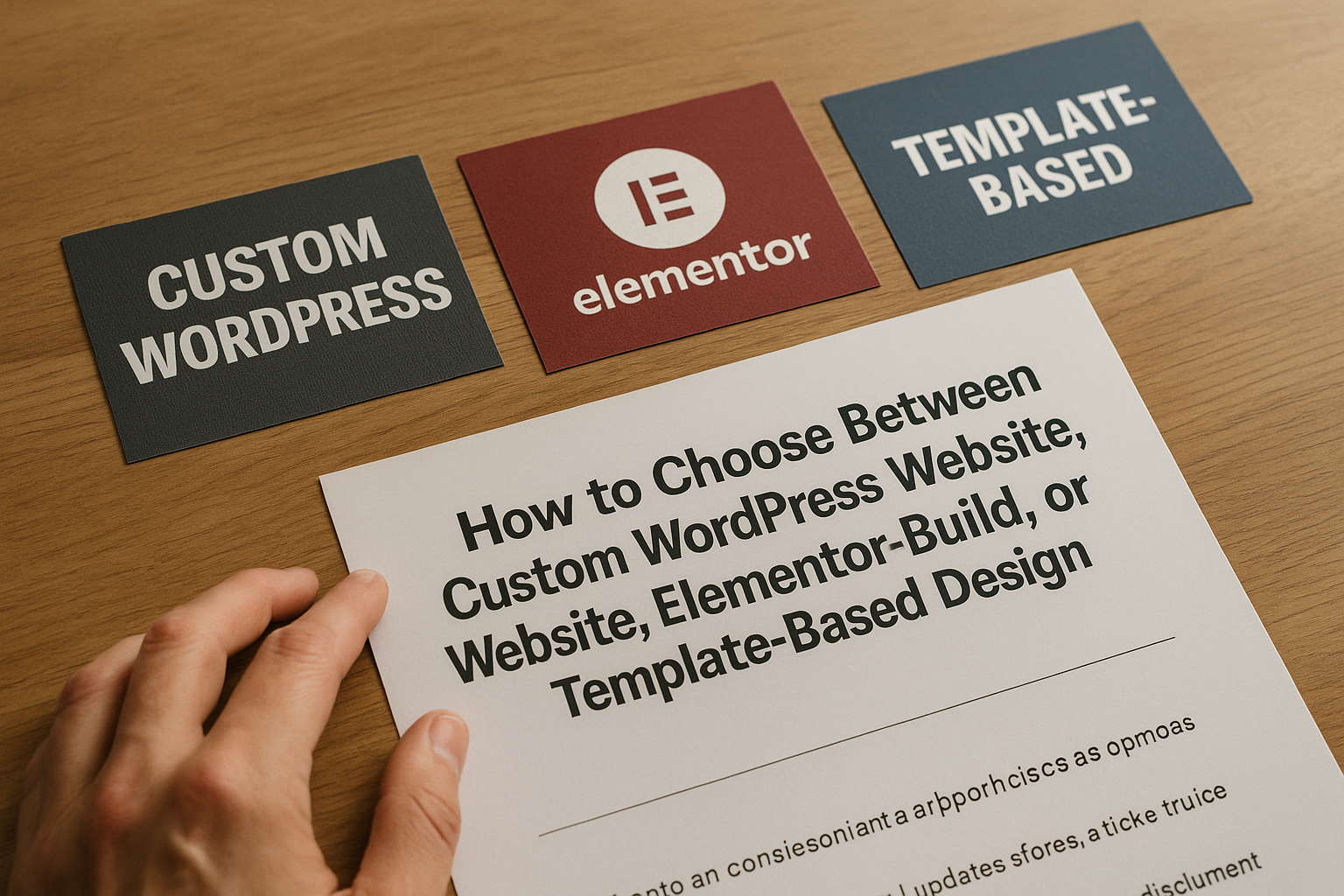
Choosing the right website approach can affect far more than design alone. It influences your branding, search visibility, user experience, update flexibility, speed, maintenance, and how well your site supports long-term business growth. For many business owners, the real decision is not simply whether to build a website, but whether to choose a custom WordPress website, an Elementor build, or a template-based design.
Each option has real advantages. Each also has limitations that become more obvious over time. The best choice depends on your goals, budget, timeline, content needs, and how important performance, customization, and scalability are to your business.
If you are comparing a custom WordPress website vs Elementor vs template options, this guide will help you understand how they differ and when each one makes the most sense.
Why This Decision Matters
Your website is often the first serious interaction a potential customer has with your business. Before they call, request a quote, schedule an appointment, or visit your location, they evaluate your company online. A site that feels outdated, generic, slow, or hard to use can reduce trust before a conversation even begins.
That is why the platform and build method matter. The right foundation can make your website easier to grow, easier to market, and more effective at turning visitors into leads.
When evaluating the best website platform for small business use, it helps to think beyond launch day. Consider what your website will need six months from now, two years from now, and as your marketing evolves.
What Is a Custom WordPress Website?
A custom WordPress website is built specifically around your business, brand, content structure, and functional goals. Instead of starting from a pre-made design, a developer creates a tailored layout, theme structure, and user experience to match your needs.
This does not necessarily mean every line of code is built from scratch, but it does mean the website is intentionally designed for your business rather than adapted from a generic template.
Advantages of a Custom WordPress Website
- Unique branding: Your site is designed around your company, not around a template used by many others.
- Better scalability: Custom builds are usually easier to expand when you need new features, landing pages, integrations, or more advanced functionality.
- Performance control: Developers can reduce unnecessary code and build with speed and efficiency in mind.
- Improved flexibility: Layouts, content sections, navigation, and conversion elements can be tailored to your exact goals.
- Cleaner long-term structure: A well-built custom site often becomes easier to manage strategically over time.
Potential Drawbacks
- Higher upfront investment: Custom development usually costs more than using a page builder or template.
- Longer development timeline: More planning, strategy, and development work are involved.
- Requires experienced support: Ongoing updates and enhancements are best handled by professionals who understand the build.
A custom website is often the best fit for businesses that want a professional, high-performing digital asset that supports serious marketing and long-term growth.
What Is an Elementor Website?
Elementor is a visual WordPress page builder that allows websites to be designed and edited through a drag-and-drop interface. It is one of the most widely used tools in the WordPress ecosystem because it can produce polished designs while making content updates more accessible for non-developers.
When comparing an Elementor website vs custom website, the biggest difference is usually how the site is built and managed. Elementor prioritizes design flexibility and ease of editing, while custom development prioritizes deeper control and cleaner structural precision.
Advantages of an Elementor Build
- Faster development: Elementor can speed up design and page creation significantly.
- Easier content editing: Business owners and teams can often update text, images, and page sections without touching code.
- Strong visual flexibility: Many layouts, animations, forms, and design elements can be built quickly.
- Good middle-ground option: It offers more customization than a basic template while remaining more affordable than fully custom development.
Potential Drawbacks
- Can become bloated: Poorly built Elementor sites may load extra code, which can affect performance.
- Design inconsistency risk: Without planning, pages can become visually inconsistent as more people edit them.
- Plugin dependency: The site may rely heavily on the page builder for layout and design functionality.
- Not always ideal for complex projects: Advanced functionality may still require custom development.
Elementor works well for many small and mid-sized businesses that want a custom-looking website with easier day-to-day editing. The quality of the final result depends heavily on how well the site is planned, designed, and optimized.
What Is a Template-Based Website?
A template-based website starts with a pre-designed theme or layout that is customized with your content, colors, logo, and images. This is typically the fastest and least expensive approach, especially for very small businesses or early-stage companies that need an online presence quickly.
Templates are common across WordPress and other website platforms. They can look attractive at first, but their long-term value depends on how closely the template matches your actual business needs.
Template Website Pros and Cons
Understanding template website pros and cons is important because templates can be either practical or limiting depending on the situation.
Pros
- Lower initial cost: Templates are usually the most budget-friendly option.
- Faster launch: Since the framework already exists, setup can be much quicker.
- Simple for basic websites: A small brochure-style site may not need advanced customization.
- Large design selection: Many templates are available for different industries and styles.
Cons
- Generic appearance: Other businesses may be using the same or similar design.
- Limited flexibility: Customizing layouts or features beyond the template structure can be difficult.
- Possible performance issues: Some templates include unnecessary features and code.
- Scalability challenges: As your business grows, the template may become restrictive.
- Inconsistent quality: Not all templates are well-coded, well-supported, or regularly updated.
A template-based site can be a sensible starting point for a business with a limited budget, a short timeline, and relatively simple content needs. It is often less ideal for businesses that depend heavily on lead generation, SEO, unique branding, or custom workflows.
Comparing Custom WordPress Website vs Elementor vs Template
1. Branding and Originality
If standing out matters, a custom WordPress website usually provides the strongest result. It allows every part of the user experience to reflect your brand identity. Elementor can also create a distinctive look when handled strategically, though it still works within a builder environment. Templates usually offer the least originality unless they are extensively customized.
2. Speed and Performance
A well-developed custom website often has the best performance potential because it can be built with cleaner code and fewer unnecessary assets. Elementor websites can perform well too, but they need thoughtful optimization. Templates vary widely. Some are lightweight, while others are overloaded with design features that slow the site down.
3. Ease of Editing
Elementor is often the easiest option for ongoing visual editing. Teams can change sections, update content, and create pages with minimal technical knowledge. Template-based sites can also be easy to manage if they are simple. Custom sites can be built with user-friendly editing tools, but editing flexibility depends on how the site was developed.
4. SEO and Site Structure
Search optimization is not determined by design method alone, but your website structure does matter. Clean code, strong mobile usability, page speed, content hierarchy, and technical setup all support SEO. A custom build usually offers the most control over these factors. Elementor can still be a strong option when properly configured. Templates may be acceptable, but poorly built ones can create technical limitations.
5. Long-Term Scalability
If your business expects to grow, add services, publish landing pages, launch campaigns, connect third-party systems, or expand functionality, a custom WordPress website usually offers the best long-term foundation. Elementor can scale well for many businesses, especially service companies and content-driven sites. Templates often become harder to evolve once your needs become more specific.
6. Budget and Timeline
Templates are typically the fastest and least expensive. Elementor usually sits in the middle, offering a balance of customization and affordability. Custom websites generally require the highest investment and the most planning, but they may also provide the highest strategic value over time.
Which Option Is Best for Different Types of Businesses?
Choose a Custom WordPress Website If:
- You want a site built specifically around your brand and sales process
- You need advanced features, integrations, or unique layouts
- Your website plays a major role in lead generation
- You care strongly about long-term scalability and performance
- You want a digital asset designed to support ongoing marketing growth
Examples include law firms, medical practices, consultants, manufacturers, multi-location businesses, established contractors, and companies investing seriously in SEO or paid advertising.
Choose an Elementor Build If:
- You want a professional website with more design flexibility than a standard template
- You want easier in-house editing after launch
- You need a balance between cost, appearance, and functionality
- You plan to add landing pages or update content regularly
- You want a site that can look custom without the cost of a fully custom build
This is often a strong fit for many service businesses, local and national small businesses, agencies, consultants, and companies that want visual flexibility with manageable costs.
Choose a Template-Based Design If:
- Your budget is very limited
- You need a simple online presence quickly
- Your website content is basic and unlikely to change much
- You are still testing a new business idea or service offering
- You understand that you may outgrow the site later
A template may work for a starter site, but it is important to think realistically about whether it will still meet your needs once your business gains momentum.
Common Mistakes to Avoid
Choosing Based Only on Price
The lowest-cost option can become the most expensive if it leads to redesigns, technical problems, poor conversion performance, or lost trust. A website should be evaluated as a business tool, not just a design purchase.
Ignoring Long-Term Maintenance
Every WordPress website requires updates, security attention, backups, monitoring, and occasional technical troubleshooting. Your decision should include not only how the site will be built, but also how it will be maintained.
Focusing Only on Appearance
A beautiful site that loads slowly, confuses users, or does not support conversions is not doing its job. Design should support business objectives, not distract from them.
Using a Template That Fights Your Content
One of the biggest problems with templates is trying to force your services, messaging, and user journey into a structure that was not built for your business. This often leads to awkward layouts and weaker results.
Assuming All Elementor or Custom Sites Are Equal
The platform alone does not determine quality. A well-built Elementor site can outperform a poorly built custom site. A strategic custom website can dramatically outperform a generic page builder setup. Planning, development quality, optimization, and ongoing support matter just as much as the initial format.
How to Make the Right Decision
Start by asking practical questions:
- What is the main purpose of the website?
- How important is unique branding?
- Will the site need to grow over time?
- Who will update the content after launch?
- How important are speed and SEO?
- Do you need custom features or integrations?
- What is your realistic budget for both launch and maintenance?
If your website is central to your marketing, reputation, and lead generation, investing in the right structure from the beginning usually pays off. If your needs are simpler, an Elementor build or a carefully chosen template may be enough for now.
The key is aligning the website approach with your actual business goals rather than selecting whatever seems quickest or cheapest in the moment.
Conclusion
There is no single universal answer in the custom WordPress website vs Elementor vs template debate. The best choice depends on your stage of growth, your marketing priorities, your budget, and how much flexibility you need.
A custom WordPress website is usually the strongest choice for businesses that want a unique, scalable, high-performance website built for long-term growth. An Elementor website is often the best middle-ground solution, combining professional design flexibility with easier editing and a more moderate investment. A template-based design can be useful for a basic launch, but it often comes with limitations that become more noticeable as a business grows.
When choosing the best website platform for small business use, think beyond launch speed and upfront cost. Focus on how well the website will support trust, visibility, usability, conversions, and future expansion. A website should not just help your business get online. It should help your business move forward.