For many business owners, one of the most common digital marketing questions is simple: should you invest in Google Ads or SEO first?
It is an important decision because both channels can help generate leads, increase visibility, and grow revenue, but they work in very different ways. Google Ads can put your business in front of potential customers almost immediately. SEO takes longer, but it can build a strong long-term foundation that continues delivering traffic over time.
When comparing Google Ads vs SEO for small businesses, the right answer depends on your timeline, budget, competition, website quality, and growth goals. In many cases, the smartest strategy is not choosing one forever, but knowing which to prioritize first and when to combine them.
This guide explains how each channel works, the pros and cons of each option, and how to decide between SEO or PPC for small business growth in the United States.
Understanding the Difference Between Google Ads and SEO
Before deciding where to invest, it helps to understand what each channel actually does.
What Google Ads Does
Google Ads is a paid advertising platform that allows businesses to appear at the top of search results for selected keywords. You bid on search terms related to your services, and your ad can appear when users search for those topics.
For example, if someone searches for a service like emergency plumbing, family law attorney, dentist near me, or commercial roofing contractor, a properly managed campaign can place your business in front of that user right away.
The main advantage is speed. Once campaigns are launched and approved, traffic and leads can begin almost immediately.
What SEO Does
SEO, or search engine optimization, focuses on improving your website so it can rank in the organic search results without paying for each click. This includes technical improvements, content creation, keyword targeting, local optimization, site speed, mobile usability, internal linking, and trust-building signals.
SEO does not usually deliver instant results, but it can create long-term visibility. A well-optimized website can continue attracting search traffic and leads even when ad spend is reduced.
That is why many businesses view SEO as an asset-building strategy, while Google Ads is often viewed as a faster lead generation tool.
Google Ads vs SEO for Small Businesses: The Core Tradeoff
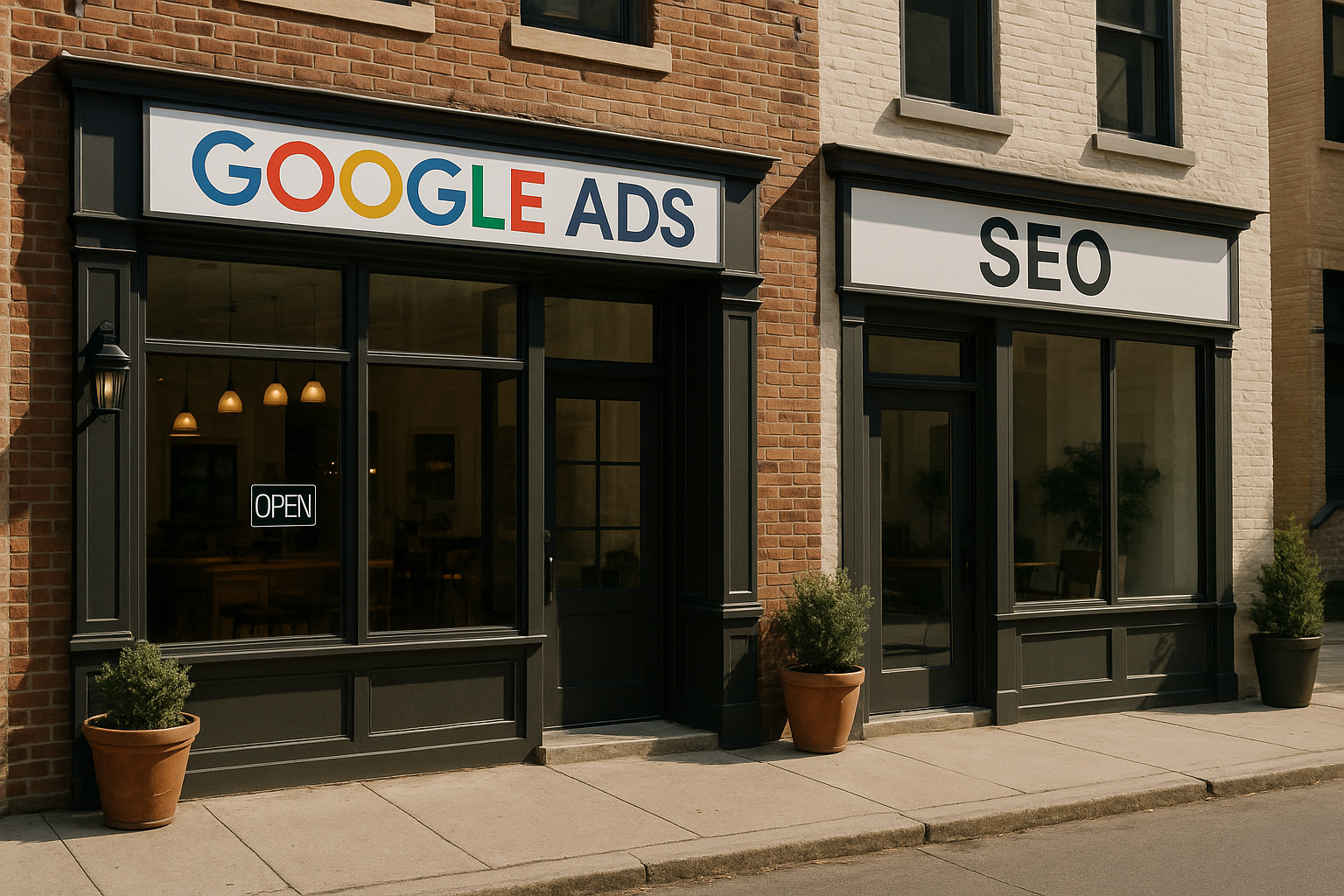
The biggest difference between the two comes down to speed versus compounding value.
Google Ads is faster. SEO is slower but more durable.
With Google Ads, you can start appearing for high-intent searches quickly, but traffic usually stops when you stop paying. With SEO, it may take months to gain traction, but strong rankings can keep producing results over a longer period.
For small businesses with limited budgets, that tradeoff matters. If you need leads now, Google Ads may be the better first investment. If you are focused on building sustainable visibility and reducing dependency on paid traffic over time, SEO may deserve early attention.
In reality, most businesses eventually benefit from both.
When Google Ads Should Come First
There are several situations where Google Ads makes the most sense as the first investment.
1. You Need Leads Quickly
If your business needs immediate inquiries, calls, quote requests, or appointment bookings, SEO may simply take too long. Google Ads is often the faster path to visibility, especially for service-based businesses targeting high-intent search terms.
This can be especially useful for:
- New businesses that need fast exposure
- Businesses entering a new market
- Companies launching a new service
- Seasonal businesses with time-sensitive campaigns
- Businesses trying to fill an immediate sales gap
2. Your Website Is New
New websites usually do not have much search authority yet. Even with strong content and technical setup, organic rankings often take time to develop. Google Ads can help bridge that gap while SEO work builds momentum in the background.
3. You Want Fast Keyword Testing
Google Ads is useful for testing which services, landing pages, offers, and keywords actually generate leads. That data can later guide your SEO strategy.
For example, if paid campaigns show that certain service terms drive better conversions than others, you can prioritize those topics in your SEO content and landing pages.
4. Your Industry Is Highly Competitive Organically
Some industries are so competitive in organic search that reaching the first page can be difficult without a sustained SEO effort. In those cases, Google Ads may provide a more practical short-term path to visibility while long-term SEO work continues.
The Strengths of Google Ads for Small Business Lead Generation
As one of the more direct small business lead generation strategies, Google Ads offers several advantages:
- Immediate visibility: Your business can appear quickly for valuable searches.
- Precise targeting: Campaigns can be built around specific services, search intent, and geographic service areas across the United States.
- Budget control: You can set daily budgets and adjust based on performance.
- Measurable performance: Clicks, calls, forms, and conversions can be tracked.
- Flexible testing: Ad copy, offers, landing pages, and targeting can be refined over time.
However, these strengths only matter when campaigns are managed carefully. Poor targeting, weak landing pages, or incorrect conversion tracking can waste budget quickly.
The Limitations of Google Ads
Although Google Ads can work well, it is not perfect.
- Traffic stops when spending stops: Unlike organic rankings, paid visibility is directly tied to budget.
- Costs can rise: Competitive industries may have expensive cost-per-click rates.
- Requires ongoing management: Campaigns need regular optimization, not a one-time setup.
- Landing page quality matters: Even great ads can fail if the website experience is weak.
For these reasons, Google Ads works best when a business has a clear budget, a strong website, and a need for near-term lead flow.
When SEO Should Come First
SEO is often the better first investment when your business is thinking beyond the next few weeks and wants to build a stronger online presence over time.
1. You Want Long-Term Growth
If your goal is to steadily increase search visibility, reduce dependence on paid traffic, and create a website that consistently attracts qualified visitors, SEO is a strong choice.
Good SEO supports long-term growth by improving how your business is discovered across search engines for relevant services and informational topics.
2. You Have a Limited Monthly Ad Budget
In some industries, paid clicks are expensive. If your ad budget is too small to compete effectively, a focused SEO strategy may be a better use of resources, especially if you can invest consistently over time.
3. Your Business Benefits From Trust and Authority
For many businesses, especially professional services and higher-consideration services, organic rankings can help build trust. Many users skip ads and go directly to the organic results, especially when researching providers, comparing options, or learning about a service before contacting a company.
4. Your Website Needs Improvement Anyway
SEO often leads to website improvements that help every marketing channel, not just organic traffic. Better page structure, stronger content, improved speed, mobile usability, clearer service pages, and stronger calls to action can benefit search visibility and conversion performance at the same time.
The Strengths of SEO for Small Businesses
SEO provides several long-term advantages:
- Compounding results: Strong content and rankings can continue generating traffic over time.
- No cost per click: You do not pay for each individual visit from organic search.
- Trust-building: Organic visibility often supports credibility and authority.
- Better website quality: SEO improvements often strengthen user experience as well.
- Support for many customer journeys: SEO can capture both immediate intent and early research behavior.
For business owners evaluating SEO or PPC for small business growth, SEO is often the better long-term investment, especially when there is patience for gradual progress.
The Limitations of SEO
SEO also has challenges:
- Results take time: It may take months to see meaningful growth.
- Competition can be strong: High-value search terms are rarely easy to win.
- Requires consistency: Content, technical improvements, and monitoring must continue.
- Algorithm changes happen: Search visibility can shift over time.
SEO is powerful, but it is not an instant lead machine. Businesses that expect immediate results are often disappointed if they misunderstand the timeline.
How to Decide Which One to Invest in First
If you are still unsure, use these practical questions to guide the decision.
Choose Google Ads first if:
- You need leads in the near term
- Your website is new and has little organic visibility
- You are launching a service or entering a competitive market
- You have a clear paid media budget
- You want fast testing and measurable short-term data
Choose SEO first if:
- You are focused on long-term growth
- You want to build an asset rather than rent visibility
- You have time to invest in gradual results
- Your budget is not large enough for sustained paid competition
- Your website needs structural and content improvements anyway
For many small businesses, the answer is not ideological. It is practical. The question is not which channel is universally better. The real question is which channel best matches your current business stage.
When to Use Google Ads and SEO Together
Understanding when to use Google Ads and SEO together is often where the best results happen.
These channels are not enemies. They are complementary.
Use both when you want short-term leads and long-term growth
This is one of the most common and effective approaches. Google Ads helps generate immediate traffic while SEO builds future visibility. Instead of waiting for organic rankings alone, your business can start generating leads now while improving long-term positioning.
Use Google Ads data to strengthen SEO
Paid campaigns can reveal which keywords convert, which messaging gets clicks, and which landing pages perform best. That information is valuable for SEO planning.
Rather than guessing what users want, you can use real search and conversion data to prioritize the right content.
Use SEO to reduce paid dependence over time
As your organic visibility improves, you may be able to reduce paid spend on some terms, shift budget toward the highest-value services, or use advertising more strategically during peak seasons or competitive periods.
Use both to dominate search visibility
When a business appears in both paid and organic results, it can occupy more search real estate and increase credibility. This can be especially helpful for high-intent service searches where visibility strongly influences lead volume.
A Practical Example for Small Businesses
Imagine a service business with a newly redesigned website and little organic traffic.
If the company invests only in SEO, it may wait several months before seeing meaningful lead growth. If it invests only in Google Ads, it may generate quick leads but remain dependent on ongoing ad spend.
A balanced approach could look like this:
- Launch Google Ads for the highest-intent service keywords
- Build dedicated landing pages designed to convert
- Set up analytics and conversion tracking
- Improve technical SEO, speed, and mobile performance
- Create optimized service pages and supporting content
- Use ad performance data to guide content priorities
This creates a smarter system where paid traffic supports immediate lead generation and SEO builds a stronger foundation for the future.
Do Not Ignore the Website Itself
One important point is often overlooked in the Google Ads versus SEO debate: neither strategy performs well if the website itself is weak.
A business can buy clicks through ads or earn traffic through SEO, but if visitors land on a slow, outdated, confusing, or unconvincing website, results will suffer.
That is why the website should be treated as part of the investment decision. Before scaling either channel, make sure your site supports conversion with:
- Fast page speed
- Mobile-friendly design
- Clear service pages
- Strong calls to action
- Trust-building content
- Easy navigation
- Accurate tracking
For many small businesses, improving the website first or alongside marketing efforts can produce better outcomes from both channels.
The Best First Investment Is the One That Matches Your Business Stage
There is no single answer that fits every company in every industry.
When evaluating Google Ads vs SEO for small businesses, the best first investment depends on whether your business needs speed, sustainability, or both.
If you need leads quickly, Google Ads often makes sense first. If you want to build durable visibility and long-term search value, SEO deserves serious attention. If your budget allows it, combining both can be one of the strongest small business lead generation strategies available.
The key is to approach the decision strategically. Paid search can deliver quick traction. SEO can build momentum that lasts. Together, they can support a more stable and scalable online presence.
Conclusion
Choosing between SEO or PPC for small business growth is not about picking a winner for all time. It is about understanding what your business needs right now and what it needs next.
Google Ads is typically the faster route to immediate visibility and lead generation. SEO is usually the stronger path for long-term growth, authority, and reduced dependence on paid traffic. For many small businesses across the United States, the smartest move is to start with the channel that solves the most urgent need, then expand into a combined strategy as the business grows.
In the end, the most effective marketing strategy is rarely built on speed alone or patience alone. It is built on using the right tools at the right stage, supported by a strong website, clear tracking, and consistent optimization over time.