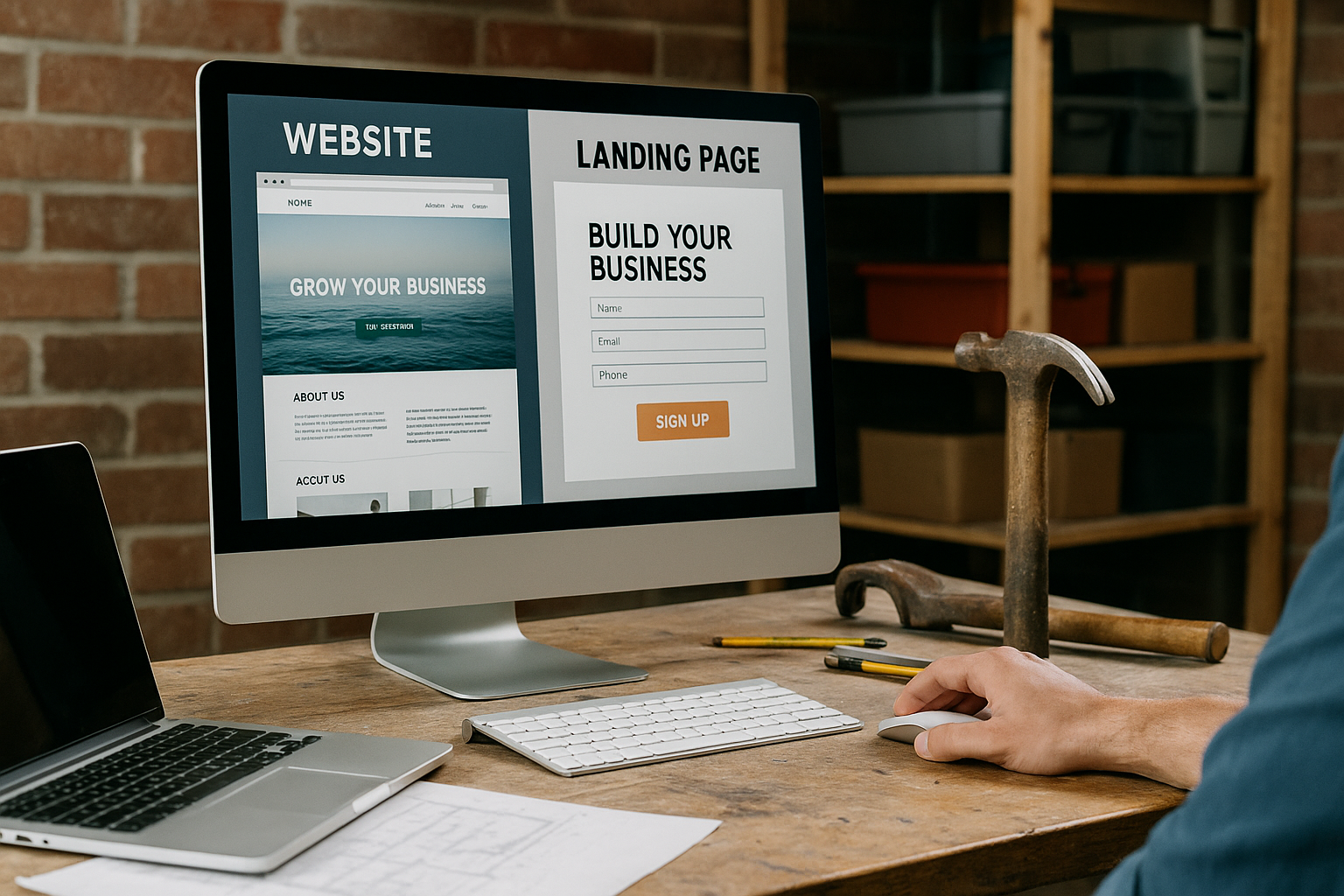
When a small business starts investing in Google Ads, one of the first big questions is whether the current website is enough or whether a dedicated landing page would perform better. For many owners, this decision affects budget, lead quality, campaign results, and how quickly advertising can start producing useful data.
If you are weighing a new website or landing page for Google Ads, the right answer depends on your business model, goals, current site quality, and how focused your ad campaigns are. In some cases, a well-built landing page is the fastest and smartest option. In others, the real problem is that the business website is outdated, hard to use, or not aligned with the services being advertised.
This guide explains how to think through that decision in practical terms. It is especially useful for local service companies and other growth-minded businesses comparing a small business website vs landing page strategy and trying to build a stronger foundation for paid traffic.
Why This Decision Matters Before You Launch Google Ads
Google Ads can drive qualified traffic quickly, but paid clicks are only part of the equation. Once someone lands on your page, they need a clear reason to stay, trust your business, and take action. If the page experience is confusing, slow, generic, or poorly matched to the ad, even a well-managed campaign can struggle.
That is why businesses should not think about ad setup in isolation. The destination page has a direct effect on user experience, conversion rate, and the overall efficiency of ad spend. A weak page can lead to wasted clicks. A focused page can help turn the same traffic into calls, form submissions, bookings, or quote requests.
For a local campaign, this is even more important. Someone searching for a service is often comparing a few options quickly. A business that provides a clear and relevant experience is in a stronger position than one sending traffic to a broad or outdated website page.
What a Google Ads Landing Page Is Meant to Do
A landing page is a purpose-built page designed around one campaign goal. Instead of trying to explain every service, company detail, and navigation path, it focuses on one offer or one audience segment. That simplicity can be powerful when paired with paid search intent.
A strong google ads landing page miami campaign page usually includes:
- A headline closely aligned with the ad message
- Clear explanation of the service or offer
- Benefits that matter to the target customer
- Trust-building elements such as business details, service areas, or process clarity
- A prominent call to action such as calling, requesting a quote, or booking
- A mobile-friendly and fast-loading design
The goal is not to overwhelm visitors. It is to help them decide quickly whether your business is the right fit and to make taking the next step easy.
When a Landing Page Is the Better Choice
Many small businesses do not need a completely new website to begin advertising. If the business already has a decent website, but the pages are too general for Google Ads traffic, a dedicated landing page can often bridge the gap.
You Are Promoting One Specific Service
If your campaign focuses on one clear service, a landing page is usually more effective than sending people to a broad homepage. For example, if a company offers multiple services but wants to advertise only one of them, the ad traffic should go to a page built specifically around that offer.
A narrow page creates better message match. Someone who searched for one exact service does not want to sort through unrelated information before finding what they need.
You Want Faster Testing
Landing pages are useful when a business wants to test demand, offers, messaging, or service positioning without rebuilding the entire website. This can be helpful for new campaigns, seasonal services, new locations, or targeted promotions.
Instead of redesigning every page on the site, the business can create one campaign-specific destination and measure how users respond. That makes the landing page a practical tool for validation and optimization.
Your Existing Website Is Fine but Not Conversion-Focused
Some websites look acceptable and contain useful information, but they were not built with paid traffic in mind. They may have too many navigation options, weak call-to-action placement, long blocks of text, or mixed service messaging. In these cases, a landing page can outperform standard website pages because it reduces distractions and makes conversion more direct.
You Are Running Local Service Ads With Focused Intent
In local paid search, intent can be very specific. A person may be looking for a service provider, requesting help soon, and comparing options on a phone. A page built around one service area, one service type, and one action can be especially effective in that environment. That is a major reason a thoughtful miami ppc landing page strategy often emphasizes clarity, local relevance, and mobile usability.
When You Probably Need a New Website Instead
A landing page can improve ad performance, but it cannot fix everything. If the underlying website has major weaknesses, building a dedicated landing page may only delay a larger issue. In some situations, the smarter long-term move is to invest in a stronger website first.
Your Current Website Looks Outdated or Untrustworthy
Design alone is not everything, but visual trust matters. If the site looks neglected, inconsistent, or difficult to use, visitors may hesitate even if the landing page itself is well written. Many users click around before making a decision, especially for higher-value services. If they move from the landing page to the rest of the site and the experience feels weak, conversions can suffer.
Your Website Is Slow or Not Mobile-Friendly
Google Ads traffic often comes from mobile users, particularly for local service searches. If your site loads slowly, breaks on smaller screens, or makes forms hard to complete, those issues can hurt results. A modern site structure may be more important than adding isolated campaign pages.
Your Core Business Messaging Is Unclear
If a website does not clearly explain who you help, what you offer, where you work, and how a customer gets started, it may need deeper content and structural improvement. A landing page can highlight one service, but it cannot fully replace a website that explains the business in a credible and organized way.
You Need a Better Long-Term Marketing Foundation
Google Ads is only one traffic source. A website also supports organic search, referrals, social media, email marketing, and direct visits. If the existing site does not represent the business well across all channels, a rebuild may create more value over time than relying mainly on stand-alone pages.
Small Business Website vs Landing Page: The Key Difference
When comparing a small business website vs landing page, it helps to understand that they serve different roles.
A Website Builds the Full Business Presence
A business website is the broader digital home for your company. It typically includes core pages such as home, services, about, contact, and possibly location pages or blog content. Its job is to establish legitimacy, answer common questions, support search visibility, and give people a complete picture of the brand.
A Landing Page Supports a Specific Campaign Goal
A landing page is narrower and more immediate. It is designed to turn one stream of traffic into one action. In a Google Ads context, that usually means reducing friction between the search query, the ad copy, and the conversion step.
The best choice is not always one or the other. In many cases, the most effective setup is a strong website supported by campaign-specific landing pages.
How to Decide Which One You Need First
If you are unsure whether to build a website, a landing page, or both, ask a few practical questions.
What Happens After Someone Clicks Your Ad?
Review the page they would see today. Is it highly relevant to the search? Does it immediately explain the service? Is there a strong next step? Is the page clean and easy to use on mobile? If the answer is no, the destination likely needs improvement before serious ad spend begins.
Does Your Current Site Support Trust?
Even if the ad page is focused, potential customers may still browse the rest of the site. Make sure the overall site supports credibility with clear branding, complete service information, contact details, and a professional user experience.
Are You Advertising One Service or the Whole Business?
If the campaign centers around one high-priority service, landing pages make sense. If you are introducing the entire business to a market and the site itself is weak, a new website may be the better first investment.
Is Speed to Launch Important?
If you need to start testing quickly, a dedicated landing page can often be launched faster than a full website rebuild. That can be useful for lead generation campaigns where data and iteration matter.
Will You Run Multiple Campaigns?
If your advertising strategy will eventually cover different services, audiences, or locations, it may be worth building a stronger website framework and then adding focused landing pages for each campaign. That approach creates both long-term brand value and short-term advertising precision.
What Makes a Good Google Ads Page for a Local Business
Whether you choose a new website page or a dedicated landing page, the destination should be built around real user needs rather than just ad traffic volume.
Strong Message Match
The page should reflect the language and intent behind the ad. If the ad highlights a specific service, location, or problem, the page should continue that message clearly. Visitors should never feel like they landed in the wrong place.
Clear and Visible Calls to Action
Users should know exactly what to do next. Depending on the business, that might be calling, filling out a form, requesting an estimate, or scheduling a consultation. The action should be easy to find without scrolling endlessly or hunting through menus.
Easy Mobile Experience
Mobile usability is essential. Buttons should be easy to tap, text should be readable, forms should be short enough to complete on a phone, and load times should be reasonable.
Relevant Local Signals
Local campaigns benefit from clear service-area references, helpful location cues, and content that feels aligned with nearby search intent. A local business does not need to overuse place names unnaturally, but the page should make it obvious where the business works and who it serves.
Focused Content Structure
A good page is organized for scanning. That means concise sections, meaningful headings, short paragraphs, and a logical flow from problem to solution to action. Paid traffic usually responds better to clarity than complexity.
Practical Examples of the Right Approach
Example 1: Existing Website Is Solid, but Ads Need Focus
A service business has a modern website with strong branding and complete service pages. However, it wants to run Google Ads around one profitable service. In this case, creating a dedicated landing page is often the smartest move. The website already builds trust, and the landing page can sharpen the ad-to-conversion path.
Example 2: Website Is Old and Hard to Use
Another business has a dated site with weak mobile performance, confusing navigation, and limited service details. Sending paid traffic there may waste budget. This business may benefit more from a website rebuild before or alongside ad campaign development.
Example 3: Testing a New Market or Offer
A business wants to promote a new service category or target a new local audience without changing the whole site first. A landing page is useful here because it allows quick testing. If the campaign performs well, the business can then expand or integrate that offer more deeply across the website.
Common Mistakes to Avoid
Sending All Traffic to the Homepage
Homepages are often too general for paid search intent. They may work for brand searches, but for service-based campaigns, they usually lack the focus needed to convert efficiently.
Assuming More Information Always Helps
A campaign page does not need to say everything. It needs to say the right things clearly. Too much clutter can reduce action.
Ignoring the Rest of the Website
Even a high-performing landing page exists within a broader brand experience. If visitors click into your site and find inconsistency or poor usability, trust can drop quickly.
Building Without a Conversion Goal
Pages should be designed around one primary action. If the page asks visitors to do too many things, results can become harder to measure and improve.
A Smart Strategy Is Often Both
For many businesses, the real answer is not choosing between a website and a landing page forever. It is deciding what to prioritize first based on business readiness and campaign goals.
A high-performing advertising setup often looks like this: a professional website that supports trust and brand credibility, plus targeted landing pages that support specific Google Ads campaigns. The website answers bigger business questions. The landing pages drive focused conversions.
This combined approach is especially helpful for businesses that want to scale advertising over time without sacrificing the broader value of a strong online presence.
Conclusion
If you are deciding between a new website or landing page for Google Ads, start by looking at the current state of your online presence and the specific goals of your campaign. A landing page is often the right tool when you need a focused, conversion-oriented destination for a specific service or offer. A new website is usually the better move when your broader site experience is outdated, unclear, or not ready to support trust across channels.
The most effective choice depends on what happens after the click. If your current website already gives visitors confidence but lacks campaign focus, a dedicated ad page may be enough. If the site itself creates friction, rebuilding the foundation is likely the smarter investment. For many businesses, the strongest long-term path is a better website supported by focused landing pages that align with search intent, local relevance, and measurable conversion goals.
By understanding the difference between a full website presence and a campaign-specific destination, small businesses can make better marketing decisions, improve ad efficiency, and create a smoother path from search to lead.