If you are planning a new website, one of the first questions you will probably ask is simple: how long does a small business website take?
The honest answer is that it depends on the size of the website, the number of decision-makers involved, the quality of the content, and how much custom functionality is required. Still, most business owners are not looking for a vague answer. They want a realistic small business website timeline they can use to plan around marketing campaigns, staffing, seasonal demand, and growth goals.
A professional website project is not just design followed by launch. It is a structured process that usually includes discovery, planning, sitemap development, content collection, design, development, revisions, testing, and launch preparation. When each phase is handled correctly, the result is a website that looks better, performs better, and supports the business long after it goes live.
In this guide, we will walk through what a website project timeline for businesses typically looks like, what can speed it up or slow it down, and what small business owners across the United States should expect from the website launch process for small business projects.
Why website timelines vary so much
Two businesses can both say they need a new website and still have completely different timeline requirements.
A five-page informational website for a local service business may move much faster than a 40-page site with lead funnels, booking tools, service-area pages, blog migration, custom forms, e-commerce features, or integrations with outside systems. Even when the technical work is straightforward, delays often happen because content is incomplete, feedback takes too long, or goals were never clearly defined at the beginning.
In other words, the timeline is shaped by both the website itself and the decision-making process behind it.
Common factors that affect project length include:
- Number of pages
- Whether content already exists
- Need for copywriting or SEO planning
- Custom design versus starting from an existing framework
- Special functionality such as forms, appointments, memberships, or e-commerce
- Number of revisions requested
- Internal approval speed
- Third-party integrations
- Hosting, domain, and technical setup readiness
That is why a realistic timeline matters more than a rushed one. A faster launch is not always better if important details are skipped.
A realistic small business website timeline at a glance
For many small businesses, a standard professional website project takes roughly 4 to 12 weeks from strategy to launch. Simple brochure-style sites may be completed sooner, while more complex projects may take longer.
| Project type | Typical timeline | What is usually included |
|---|---|---|
| Simple small business website | 4 to 6 weeks | Basic strategy, a small number of pages, standard contact forms, mobile optimization, launch setup |
| Standard growth-focused website | 6 to 10 weeks | Strategy, custom design, copy refinement, SEO structure, lead-focused pages, testing, launch preparation |
| Complex or custom website | 10 to 16+ weeks | Advanced functionality, integrations, large page count, custom workflows, e-commerce or booking systems |
These ranges are not guarantees, but they are useful benchmarks. The key is understanding what happens during each phase.
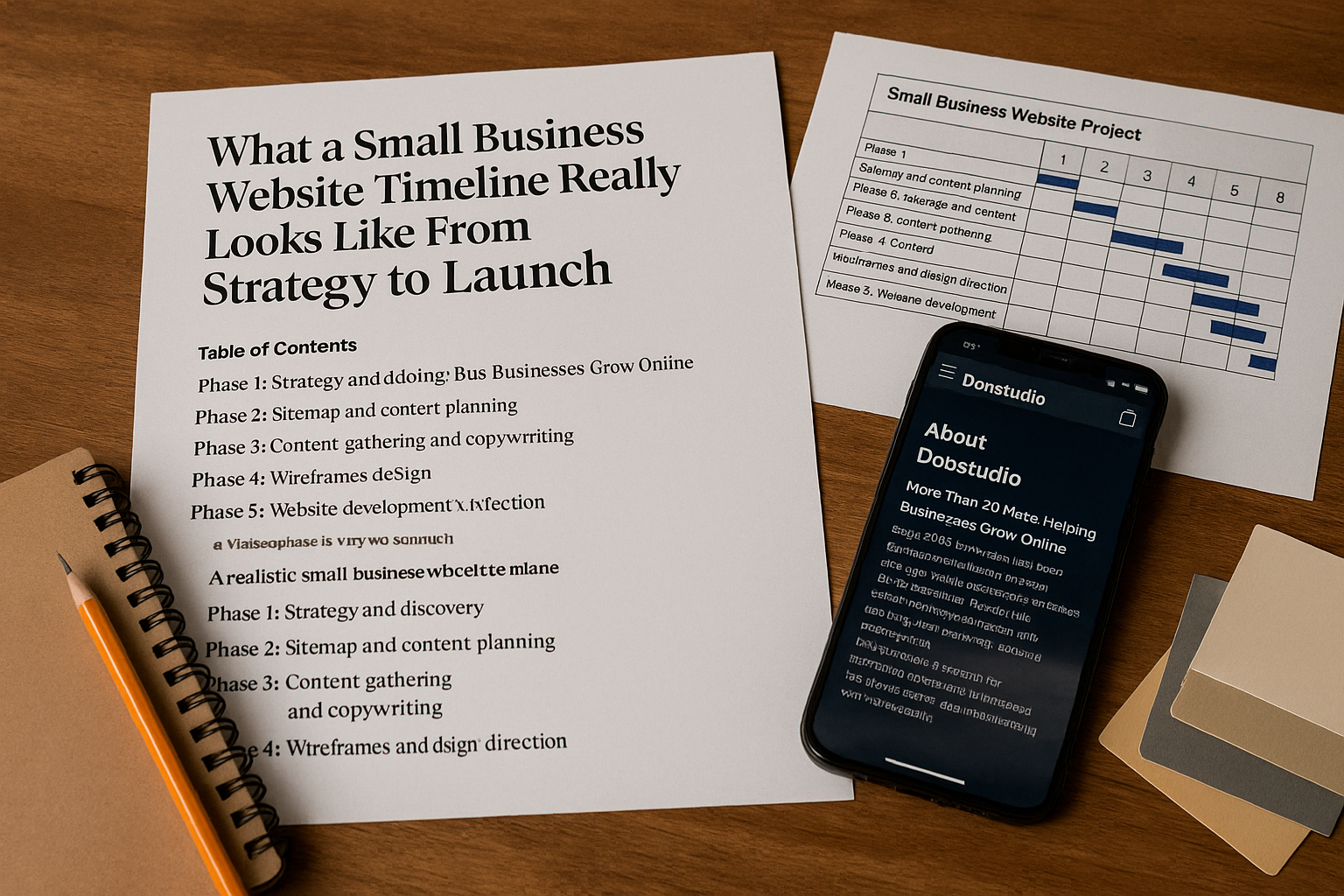
Phase 1: Strategy and discovery
Typical timeline: 3 to 7 days
Every successful website should begin with strategy. This is where goals become clear and the project starts to take shape.
During discovery, the business and web partner usually define:
- The purpose of the website
- Primary services or products
- Target audience
- Main conversion goals
- Key competitors or market expectations
- Brand positioning
- Required features and functionality
This stage often seems simple, but it has a major impact on the full small business website timeline. If the strategy is rushed or unclear, the project may move quickly at first and then slow down later because major decisions need to be revisited.
For example, a business may initially think it needs only a few service pages, then realize it also needs industry-specific landing pages, quote request funnels, downloadable resources, or separate areas for multiple customer types. It is better to uncover those needs early.

Phase 2: Sitemap and content planning
Typical timeline: 3 to 7 days
Once the goals are clear, the next step is planning the website structure. This usually includes a sitemap and page-by-page content plan.
The sitemap outlines which pages will exist and how users will navigate between them. A thoughtful structure helps both visitors and search engines. It also prevents wasted time later in the project.
Typical pages for a small business website may include:
- Home
- About
- Services or product pages
- Industries served
- Gallery or portfolio
- Testimonials
- Blog
- Contact
- Privacy policy and legal pages
This phase also helps clarify whether additional SEO-focused content should be included from the start. Businesses that want stronger long-term visibility often benefit from a more complete site architecture rather than launching with only the bare minimum.
Phase 3: Content gathering and copywriting
Typical timeline: 1 to 3 weeks
This is one of the most important parts of the website launch process for small business projects, and one of the most common sources of delay.
Many business owners underestimate how much content a professional website requires. Even a relatively small site may need:
- Service descriptions
- Company background
- Calls to action
- Team details
- Photos or approved stock imagery
- Testimonials
- Licensing or credential information where relevant
- Policies and disclaimers
If the client is writing content internally, progress often depends on how quickly drafts can be created and approved. If copywriting support is part of the project, the process may move more smoothly, but it still requires review and feedback.
When people ask, how long does a small business website take, the answer often depends less on coding and more on content readiness.
Projects move faster when:
- Content owners are assigned early
- Existing brochures, PDFs, or old website text are organized in advance
- Images are collected before design begins
- Approvals are centralized through one primary decision-maker
Phase 4: Wireframes and design direction
Typical timeline: 1 to 2 weeks
Once structure and content direction are established, design begins. Depending on the project, this may start with wireframes, homepage concepts, or a design system that defines typography, colors, spacing, buttons, and section styles.
The goal is not just to make the website attractive. The design should support trust, usability, and conversions.
For small business websites, good design decisions usually focus on:
- Clear navigation
- Strong mobile usability
- Fast visual understanding of services
- Easy contact opportunities
- Professional credibility
- Consistent branding
This phase often includes revision rounds. Quick, focused feedback keeps momentum going. Delays happen when feedback is fragmented, subjective, or spread across too many stakeholders.
Phase 5: Website development
Typical timeline: 1 to 3 weeks
After design approval, the build phase begins. This is where the approved design becomes a functioning website.
Development typically includes:
- Building page layouts
- Configuring mobile responsiveness
- Creating forms
- Setting up menus and navigation
- Adding content and media
- Applying performance best practices
- Configuring basic security settings
- Installing and setting up needed tools or plugins
If the website is being built on WordPress, the developer may also configure the content management structure so the business can update text, images, blog posts, and key sections more easily after launch.
This phase can be relatively fast on a straightforward project. It takes longer when there are advanced features such as booking tools, member areas, quote calculators, e-commerce functionality, CRM integrations, or custom-coded elements.
Phase 6: SEO setup and technical optimization
Typical timeline: 2 to 5 days
Search visibility should not be treated as an afterthought. Even if a business plans to invest in advertising, the website should still be built on a strong SEO foundation.
Basic SEO and technical setup often includes:
- Page title and meta description structure
- Heading hierarchy
- Clean URLs
- Image optimization
- Internal linking
- Schema where appropriate
- Indexing controls
- XML sitemap setup
- Analytics and search console configuration
For businesses that rely on lead generation, local visibility, or content marketing, this stage is especially important. A rushed launch without proper technical setup can create avoidable cleanup work later.
Phase 7: Review, revisions, and quality assurance
Typical timeline: 3 to 7 days
Before launch, the site should go through structured review and testing. This phase is where the website is checked not only for appearance, but also for functionality and usability.
Typical review items include:
- Mobile responsiveness across devices
- Form testing
- Link testing
- Layout consistency
- Spelling and grammar review
- Browser compatibility
- Page speed checks
- Image display quality
- Navigation flow
- Calls to action
This is also the point where final client revisions are usually submitted. The more organized the feedback, the easier this phase becomes.
A common best practice is to consolidate all revision notes into one document or one approval thread rather than sending scattered requests across multiple emails and messages.
Phase 8: Launch preparation
Typical timeline: 1 to 3 days
Launching a website is not just pressing a button. There are several technical steps involved in moving the site from staging or development mode into a live public environment.
Launch preparation may include:
- Final backups
- Domain and DNS coordination
- Hosting checks
- SSL certificate verification
- Final SEO visibility settings
- Analytics confirmation
- Redirect setup if replacing an old site
- Cache and performance checks
If the business already has an existing site, this phase becomes even more important. Redirects and page mapping help preserve user experience and reduce traffic disruption.
Phase 9: Website launch and post-launch review
Typical timeline: launch day plus 1 to 2 weeks of monitoring
Once the website is live, the project is not truly finished. The first days after launch often involve checking forms, traffic data, indexing, user behavior, and any small technical issues that only appear in the live environment.

Post-launch monitoring may include:
- Verifying form submissions
- Reviewing traffic and tracking data
- Confirming pages are indexable where intended
- Watching for broken links or display issues
- Checking performance under real traffic conditions
- Handling minor fixes or adjustments
This is one reason many businesses value ongoing support. A website is not a static brochure. It is a digital business asset that benefits from maintenance, updates, and gradual improvement over time.
What usually delays a small business website project
Even well-planned projects can slow down. In many cases, the delay has less to do with development and more to do with communication and readiness.
The most common causes of website delays include:
- Late content delivery
- Unclear goals at the start
- Too many people giving conflicting feedback
- Slow approval cycles
- Scope changes in the middle of the project
- Missing logins, domain access, or hosting information
- Last-minute feature additions
For example, a business may start by requesting a standard informational site, then later decide to add a store, appointment system, or multiple location pages. These additions are often worthwhile, but they affect the timeline.
How to keep your website project on schedule
If you want a smoother website project timeline for businesses, preparation makes a major difference.
Here are practical ways to help the project move efficiently:
Choose one main point of contact
One decision-maker or project lead can gather internal input and provide clear direction. This reduces confusion and speeds up approvals.
Organize your content early
Collect existing brochures, service descriptions, brand assets, team bios, photos, and legal text before the build begins.
Be realistic about revisions
Refinement is normal, but constant major changes after approval can extend the schedule significantly.
Define priorities clearly
Know what must be included at launch and what can be added in a second phase. Not everything has to happen on day one.
Prepare technical access
Have domain, hosting, email, analytics, and platform logins available if needed.
Think beyond launch day
A strong launch is important, but long-term performance matters more. Plan for maintenance, updates, SEO improvements, and future content growth.
What a healthy timeline says about a project
Some business owners worry if a project takes several weeks. In reality, a thoughtful timeline is often a sign that the website is being handled properly.
A professional website should reflect real business goals, communicate clearly, work well on mobile devices, load efficiently, and support future marketing efforts. Those things take planning.
When the process is too rushed, businesses often end up with:
- Thin content
- Weak messaging
- Poor SEO structure
- Limited conversion planning
- Missed testing issues
- A website that needs rework soon after launch
That is why the best answer to how long does a small business website take is not just a number. It is a process with defined stages and realistic expectations.
Final thoughts on the small business website timeline
A typical small business website timeline usually falls somewhere between 4 and 12 weeks, depending on content readiness, scope, functionality, and how efficiently decisions are made. Simple sites can launch faster, while more strategic or custom projects naturally require more time.
The most successful website launch process for small business owners is one that begins with strategy, moves through clear content and design phases, includes proper development and testing, and continues with post-launch support. That approach creates a website that does more than simply exist online. It creates a website that helps the business build trust, attract leads, and grow over time.
If you are planning a new website, the best next step is to think in phases rather than just deadlines. A good website is not built in a single moment. It is built through a deliberate process that turns business goals into a reliable digital asset.